ב"ה


From the holidays into the everyday
On Sukkot, pilgrims travelled from all over the land of Israel to visit the Holy Temple in Jerusalem. In order not to inconvenience the traveler who lived furthest from the Holy City as he trekked home, the prayer for rain is delayed for 15 days, until the 7th of Cheshvan. In addressing this subject, this class offers the tonic to the inevitable post-holiday blues. (Based on Likutei Sichos, volume 20)


What if the way you judge other people says less about them and more about you? A rabbi spent his entire life treating his criminal neighbors with kindness, but they only changed after he died. Was there a flaw in his approach, or was something on their end standing in the way? This lesson unpacks a story from Tractate Sanhedrin to examine the gap between judging others favorably and judging yourself honestly, and the role that gap might be playing in your own life.



Smashing Idols
The famous story from the Midrash about how Abraham destroyed the idols in his father's shop. An excerpt from the full DVD “Young Abraham”.


The Jew’s Eternal Connection to the Land of Israel
When G-d informs Abraham that the land of Israel belongs to him and his seed, G-d states that He has in fact already given them the land, and yet, on another occasion, G-d told Abraham that only in the future will He give the land to his offspring? In resolving this apparent contradiction, this class will explore the multi-layered relationship between the people and the land. (Likutei Sichos vol. 15)


Parshah Curiosities: Lech Lecha
A superficial reading of the biblical account of Abraham and Sarah’s episode in Egypt, where he tells her to say she’s his sister so they don’t kill him, is shrouded in mystery. Delve into the classical commentaries and discover the missing link in this fascinating narrative.

Parshah Curiosities: Lech Lecha
The portion of Lech-Lecha begins with G-d calling Abraham to his destiny. Strangely, in the glowing promises of the glorious future awaiting him, the Torah specifically mentions a name change. But why would modifying something as external as a name be such a big deal? This lecture reveals the true meaning of your Jewish name—as far more than a simple label for convenience. You'll discover why Abraham (and Sarah’s) names required modification and learn to appreciate the deeper meaning behind the incredible evolutionary process that produced the world's first Jews!

Parsha Curiosities: Lech-Lecha
A fascinating exposé of the traditional chair universally designated for the Prophet Elijah at a Brit Milah ceremony. This lecture begins by fleshing out the spiritual character and impact engendered by sacred circumcision. We then proceed to peel away historical layers of deep meaning as we trace the surprising origins of the proverbial participation of Elijah a.k.a. the Covenantal Angel. Ultimately, you’ll see why all of this is as relevant as quantum physics, and makes all the difference today!

Abraham’s arrival in the land of Canaan immediately engenders prophetic promises of progeny and future possession of this land. Following his Egyptian detour, resultant wealth and family feuds; we return to the original narrative. The promise is reiterated, yet much changes. Surprisingly, Abraham doesn't seem to obey instructions. Amazing details emerge, offering a dazzling new appreciation for the holy city of Chevron; as a fascinating narrative of the dead who return completes this exquisite presentation.


Imagine if at the age of 75, a voice from the sky instructs you to leave the comfort of your home and everything familiar to you. Would you just pack it all up and leave the land you have known all your life? Why does the Torah omit the incredible and inspiring stories that brought Abraham to this point in the first place? How does the simple act of traveling bring joy to G-d? How do our own desires, emotions, and thoughts hold us back from finding happiness? Let’s find out together in class one.


It can be intimidating and discouraging to hear others say that we have such great potential, when we know how far we fall short. When we think about our personal natural abilities, they may indeed be limited. By learning to tap into the potential G-d implanted in us, we can stretch and reach farther than we could ever imagine. Gain insights and tools to tap into the infinite.





Children’s Rally, 25 Kislev, 5741 • December 3, 1980
The Chanukah battle and victory were immortalized by the Sages. The candles evoke the memory of the small group of Jews who fought those who had opposed the Torah.
Today, we each battle our own evil inclination as well. Our victories, as well, will be eternally remembered.
Our current mission and battle is for the coming of Moshiach, as we request three times a day during prayer. Although we only request his coming three times a day, we yearn for him “all day”!


7th Night of Chanukah, 5748 · December 21, 1987
When a Jew celebrates Chanukah, he may be confronted: “You Jews are so few compared to
the nations of the world. Yet you hold fast to your customs and commandments, ignoring what
the billions of non-Jews around you think and do… Wherein lies your strength to stand in the
face of such odds?”

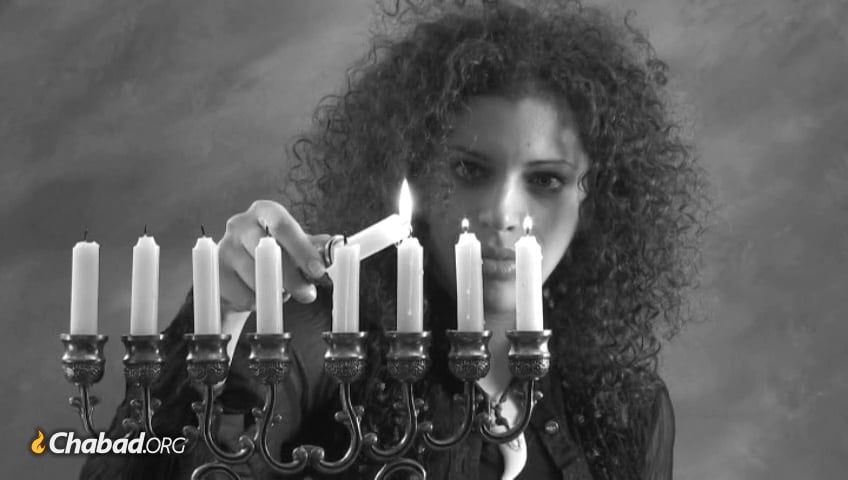


Chanukah reminds every Jew that it is G-d’s eternal mandate to carry the torch of His
“Mitzvah-candle and Torah-light.” With most Mitzvos, the “candle” and “light” are not
physically visible. But with the Chanukah candles we see how fulfilling the Mitzvah creates
actual physical light that illuminates all one’s surroundings.


Two Versions of the Timeline of the Maccabee's Victory
Among the early Talmudic commentaries, there are two opinions about the chronology of events commemorated on Chanukah. One says that the war was won on the 24th of Kislev and that the first day of Chanukah, the 25th of Kislev, is the anniversary of the first day of peace. The other says that on one day, the 25th of Kislev, the Maccabees both won the war and rededicated the Temple.


Get the Chabad.org Video app